
"Arabica growth"
5000 article(s) found

Indonesian Java Robsta Coffee can replace Arabica _ Java Robusta Coffee Bean Cup Meter
Professional coffee knowledge exchange more coffee bean information please follow coffee workshop (Wechat official account cafe_style) Robusta Robusta Indonesian coffee representatives have Java and Sumatra Mantenin, it is generally believed that Indonesian coffee bean flavor is mellow and not high acidity, but also with a similar flavor of traditional Chinese medicine and soil, rich texture, quite distinctive. For example, Robes from Java
How much is Arabica coffee per jin? Characteristics of Arabica coffee bean, a native tree species of coffee
Professional coffee knowledge exchange more coffee bean information Please note that the coffee workshop (Wechat official account cafe_style) is also a member of Arabica, why are some coffee beans so expensive? There are tens of thousands of coffee tree species in the world, and many varieties are gradually emerging to say hello to everyone. I also hope that while tasting coffee, we can understand where coffee comes from and enter.

What are the differences between Arabica and Robusta?
Coffee is an evergreen shrub native to Ethiopia in East Africa. The main tree species can be divided into three original species: Arabica, Robusta and Liberia. At present, the most important coffee beans in the world trade mainly come from two original species: Arabica and Robusta. This coffee bean cultivation method, growth environment, shape and other conditions and characteristics have

Graphical planting techniques for the growth process and ripening process of coffee beans
There are four kinds of coffee trees in the world, but the coffee we drink now is mainly the fruit of two kinds of coffee trees, one is Arabica, the other is Robasta. Coffee trees in Arabica are not easy to grow, many are on high-altitude slopes, and picking needs to be done manually. But it is better than the balanced taste and coffee.

Coffee theory study: coffee plant classification, cultivation and processing
Many people are familiar with coffee powder, but coffee powder is formed after coffee beans are ground. The coffee beans that ordinary customers get are fried (roasted) coffee beans, while coffee beans that have not been roasted are green coffee beans. If you dig deeper, coffee beans come from coffee berries on coffee trees, which are the seeds of coffee trees. So to understand coffee beans, first you have to understand coffee.

A brief introduction to the main factors of the growth environment of coffee beans whether coffee beans contain sugar and why they taste sweet
Professional coffee knowledge exchange more coffee bean information please follow the coffee workshop (Wechat official account cafe_style) front street-coffee growth environment, composition introduction coffee bean growth environment climate is the decisive factor for coffee cultivation, coffee trees are only suitable for growing in the tropics or subtropics, so the zone between 25 degrees south and north latitude is the most suitable for growing coffee. And this coffee production zone, one.

Knowledge of boutique coffee-the growth process of coffee
Looking at this pure black liquid, it took a year of growth, harvesting, production, baking, grinding, extraction, and finally condensed into that mellow taste. Like all the things that have been polished by time and hands, such as red wine, such as jade, there is an infinite world lurking in a small space. Coffee beans would rather be as old as thousands of years ago.

Coffee Encyclopedia on the growth of Coffee trees
Coffee trees are evergreen shrubs or trees belonging to the Rubiaceae family. Wild coffee trees can grow to a height of 5 to 10 meters, but coffee trees planted in the manor are often cut to a height of less than 2 meters in order to increase their yield and facilitate harvesting. The opposite leaves of the coffee tree are long oval and greasy, with long branches and few branches at the end, while the flowers are white and open on the petiole to connect the base of the branch.
The influence of growth Environment on Coffee beans introduction to the pedigree and varieties of Coffee
The growing environment of coffee coffee trees are suitable for growing in tropical and subtropical climatic regions (between the Tropic of Cancer). Due to the cultivation in Asia, America and Africa, it forms a ring around the earth, so it is known as the "coffee belt" Coffee Belt. There is a lot of sandy soil in these areas; and with plenty of sunlight and plenty of rainfall, it is really suitable for growing coffee.

Is Arabica coffee stronger? How to distinguish Robusta Arabica Libya coffee
Professional coffee knowledge exchange More coffee bean information Please pay attention to coffee workshop (Weixin Official Accounts cafe_style) Mantenin's Robusta lineage, Arabica beans or Katim or Katim? [I'm sure you've all seen chain coffee shops emphasize that they use "100% Arabica coffee beans," but why do they emphasize this coffee variety so much?] of Arabica
A brief introduction to the description of the flavor, taste and aroma characteristics of robusta coffee beans why the harm of robusta beans is notorious
Its flavor is so bright and strong, but if you want to taste it directly, you have to be prepared. In general, robusta coffee is used in instant coffee (which extracts about twice as much liquid as Arabica), canned coffee, liquid coffee and other industrial coffees. The content of caffeine is much higher than that of A.

Arabica coffee cultivation techniques Multi-stem shaping and cultivation of coffee trees
Multi-stem integer Multi-stem integer is an integer method that uses the first branch as the main result branch. The purpose of integer is to cultivate multiple trunks and grow a large number of robust first-order branches. Multi-trunk trees do not pick the top. As a result, when the yield decreases after 3 to 5 years, new trunks are replaced.① Cultivation of multi-stem method oblique planting method: When planting, the seedlings are obliquely planted, generally at an angle of 30~60 degrees with the ground. oblique planting can inhibit

Variety types in the growth process of coffee trees
Native to Brazil, it is another hybrid tree species; somewhere between CATURRA and MUDO NOVO. The tree is usually low in shape, but slightly taller than CATURRA and easy to harvest, and the coffee fruit begins to bear fruit in late summer. It has more sour taste, and good sour taste makes you secrete salivary acid like lemon and orange, which is usually produced at high altitude and high density.
Growth characteristics of Coffee trees
Coffee trees belong to the evergreen family of Akanaceae. They are tropical plants and are not cold-tolerant. Most of them are planted in areas with elevations of 300,400m, and also in highlands with elevations of 2000-2500 meters. But those who plant on slopes above 1500 meters above sea level have better quality.
Coffee Tree species Segmentation Coffee planting Environment requires in-depth understanding of Coffee
One of the characteristics of a coffee tree is that its fruit can bear fruit several times a year, and another is that flowers and fruits (also known as cherries) coexist at different stages of ripening. The style of the whole coffee industry is influenced by the fickle nature. If the fruit is too ripe, the beans in it will rot. If it is not ripe enough, the beans picked will not ripen by themselves. So bean pickers

Kenyan coffee-producing countries with rich conditions for growing coffee beans
The highest temperature of the year is 22: 26 ℃ and the lowest is 10: 14 ℃. These conditions are very suitable for the excellent growth of Arabica beans. And high-quality Arabica coffee beans, its suitable growth conditions are on the slope of 900m ~ 2000 m above sea level in the tropics, the suitable growth temperature is 1524 ℃, the higher humidity, the annual rainfall is not less than 1500 ml, the soil is fertile and suitable for acidity and alkalinity.
Growth habits of Coffee
Coffee trees belong to the evergreen family of Akanaceae. They are tropical plants and are not cold-tolerant. Most of them are planted in areas with elevations of 300,400m, and also in highlands with elevations of 2000-2500 meters. But those who plant on slopes above 1500 meters above sea level have better quality. Coffee trees are most suitable for growing at an average temperature of about 20 degrees Celsius and an annual precipitation of 1500-2000 mm.

The natural conditions of coffee cultivation Arabica requires high planting conditions in order to produce high quality.
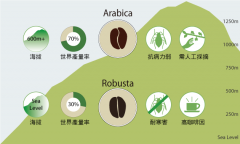
Professional coffee knowledge exchange more coffee bean information please pay attention to the coffee workshop (Wechat official account cafe_style) front street-Arabica coffee planting conditions introduction the higher the elevation of coffee trees, coffee quality will be relatively good, such as Arabica beans are in the altitude of 1000-2000 meters above sea level, Robbosa beans are generally located in the plains below 800m

Yunnan small Coffee with long aftertaste treatment method of Grinding degree and Baking degree of Fine Coffee beans in Huaguoshan
Cardamo Catimor is an improved variety of Tiebika seed, with 25% Robusta gene Yunnan small-grain coffee with good quality. Take Lujiangba small-grain coffee as an example: the percentage contents of the main components are as follows: crude fat 17.1, reducing sugar 0.93,starch 3.07,nitrogen 2.27,crude protein 1.419, ash 3.70,19.33 crude fiber, 2.14,9.20 sucrose and 6.87 moisture. Cloud

A brief introduction to the planting market price of Yunnan small-grain coffee Huaguoshan boutique coffee bean varieties with moderate sour taste
Yunnan coffee is a variant of Arabian original species, which has been cultivated for more than one hundred years after long-term cultivation and domestication. Due to the unique geographical environment and climatic conditions, Yunnan coffee has formed a unique flavor of strong but not bitter, fragrant but not strong, with a little fruit flavor. World-class coffee experts evaluate it as the best coffee in the world, and its cultivation